Emily Petricola
Emily opens up about managing her menstrual cycle and hormonal contraception while also managing multiple sclerosis.
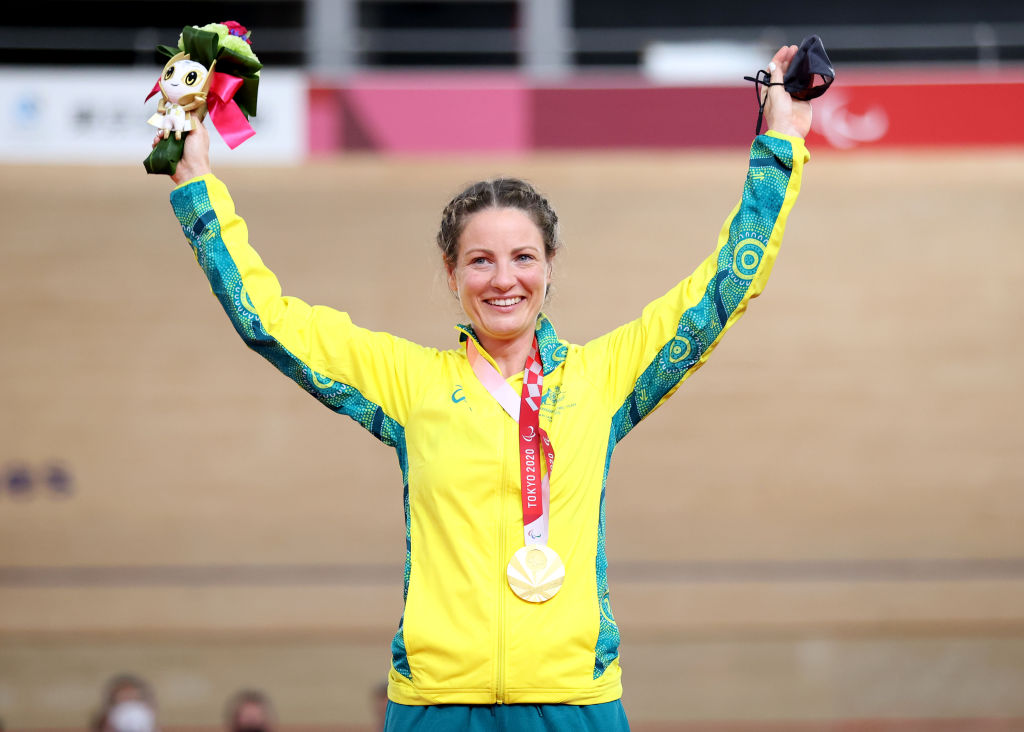
Emily Petricola
Rowing / Cycling
Emily opens up about managing her menstrual cycle and hormonal contraception while also managing multiple sclerosis.
As tricky as it can be for female athletes - and women in general - to navigate the vagaries of the menstrual cycle, reigning quadruple world champion para-cyclist Emily Petricola faces additional challenges in the week each month that she truly dreads.
Emily, a former elite rower, was diagnosed with multiple sclerosis at the age of 27. After seven years without being able to exercise, for even heated swimming pools were too warm, she first jumped on a bike in 2015. At 40, she is now training for the postponed Tokyo Paralympics.
But the debilitating disease that attacks the central nervous system brings other complications. During the week before her period, what Emily describes as her “pretty significant" MS symptoms are at their most severe.
For many, help for premenstrual syndrome comes in the form of hormonal contraception; for Emily, the problem is the fact that the pill can elevate core body temperature by half-to-one per cent.
It may seem trifling, but the physical consequences, especially during vigorous competition in the Japanese heat of August-September, means this champion para-athlete has to look for options elsewhere.
“I just know that one week out of every month, there’s gonna be a lot of trouble,’’ she says. “I’ll be really tired and almost looking for my period to come so I can start to feel better. It’s actually the second day of my period I start to come good again.’’
Just over a year ago, Emily started with Paralympic physiotherapist Keren Faulkner and began an on-off conversation around pre-cooling strategies and trials ahead of a fortnight of competition in Tokyo involving two different track and road events and two types of cycles: the two-wheeled and menstrual kinds.
Various experts agree that the pill is not ideal for Emily, for whom a rise in body temperature exacerbates her existing MS symptoms and leads to a loss of power, function and balance, as well as contributing to more extreme fatigue.
“I’ve got lesions in my brain and my spinal cord, and when I’m hot my core temperature comes up to make those lesions more problematic, so any issues that I’ve had can become more prominent with heat, and that can further compromise my grip and the co-ordination of my left leg so that it becomes really challenging.’’
On the track, the individual pursuit is shorter and thus should be more manageable; the time trial on the road, though, lasts around 40 minutes. Difficult? Very.
Thus, the plan is for an all-progesterone Merina (IUD) to be inserted in April. Emily is a guinea pig of sorts, and happy to be.
So, does she ever wish she was, well, male?
“All the time. Every month!’’ she laughs. "Men have got no idea how much more difficult this stuff is to manage for us!
“It’s really complicated. I’ve coached male and female athletes at a school level (in rowing), and it is something you have to think about - especially when you’re dealing with teenage girls.
“It’s an important area of study and definitely one that needs a lot more emphasis and research and a greater understanding at both the athlete and the coaching level.
“As people go through coaching modules and education from this point forward you would hope it would be part of the way we teach our coaches, because no-one just coaches men or coaches women any more.
“You need to be able to coach both sexes and to be able to do that effectively with females you need to have a really strong understanding of how this can impact any athlete, also know how to deal with any questions that might arise.
“There needs to be a generalised understanding of how the (menstrual) cycle works. But, more than that, coaches also need to be able to pick up on when something isn’t right.’’