Sports Physiology
How physiology contributes to improving sport performance.
Physiology is the biological science focussed on how the various organs and systems function individually and together in the human body. 1
In the case of exercise, physiology looks at the acute responses and chronic adaptations to a wide range of physical exercise conditions. 2
A sports physiologist studies how an athlete's body adapts or responds to exercise and their environment (such as changing altitude, temperature, humidity) in order to enhance and refine overall fitness and athletic performance. 4
Physiology in sport and exercise
Sport and exercise physiology is a diverse discipline that includes a number of sub-disciplines, including: 3
- Altitude training
- Exercise in the heat (thermoregulation)
- Biochemistry and haematology
- Immunology
- Performance recovery
- Tapering
- Talent Identification
- Anthropometry
- Smart sensors and devices
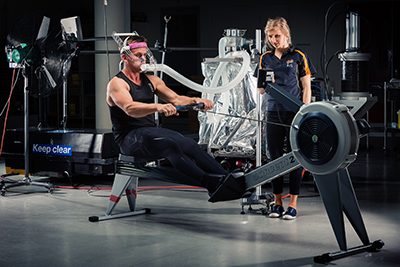
Sports physiologists perform a broad range of tasks that contribute to individual and/or team sport performances. This can include: 3, 4
- Identifying and quantifying an athlete’s physical and physiological characteristics in laboratory or field settings.
- Establishing the physiological and performance demands of competition.
- Modelling and monitoring training sessions or performance to accurately quantify physical load/stress placed on athletes.
- Determining and implementing effective interventions to improve sports performance (e.g., training, dietary, recovery, environmental, technological).
- Maintaining, evaluating, and developing sport technology and scientific equipment.
- Educating and providing relevant advice to athletes, coaches, peers, and students.
- Travelling with athletes and teams to training camps or competitions.
- Conducting applied research projects to enhance sports performance.
- Presentation and reporting of testing and research outcomes.
Groups, societies and professional bodies
Sports physiology covers a range of disciplines and therefore a number of societies may be applicable.
Exercise & Sports Science Australia, opens in a new tab (ESSA) is a peak professional organisation representing about 11,000 members, including student members. They are committed to establishing, promoting and representing the career paths of tertiary-trained exercise and sports science practitioners including Accredited Exercise Physiologists, Accredited Exercise Scientists, Accredited Sports Scientists, and Accredited High Performance Managers.
Sports Medicine Australia (SMA), opens in a new tab is a national multidisciplinary organisation committed to enhancing the health of all Australians through safe participation in sport, recreation and physical activity.
The International Council of Sport Science and Physical Education, opens in a new tab is the world’s largest network of organisations and institutions concerned with sport, sport science and physical education, accounting for millions of people. The organisation aims to 1) investigate for a better scientific understanding of all facets of human movement; 2) educate for a better quality of life and improved health for all people; and 3) advocate for the benefits related to an active lifestyle and the ethical values inherent in sporting activity.
The International Society for the Advancement of Kinanthropometry (ISAK), opens in a new tab was founded as an organisation of individuals whose scientific and professional endeavour is related to kinanthropometry (the area of science concerned with the measurement of human body composition). ISAK has developed international standards for anthropometric assessment and an international anthropometry accreditation scheme (IAAS).
Vocational educational training
The path to becoming a sports physiologist can be varied. The main path is generally via an undergraduate degree followed by a postgraduate degree, such as honours, masters or PhD in Exercise Science, Human Movement, Sport Science, Physical Education or a related field.
Sports physiologists can practice in a variety of settings and may work as permanent employees, consultants, be self-employed, occupational trainees, or volunteers. In Australia, the majority of sports physiologists are associated with National Institute Network (NIN) institutions, national sporting organisations (NSOs), and/or professional sporting teams.
Standards
The Australian Performance Support Practitioner Minimum Standards represent the minimum standards for Performance Support staff and contractors engaged to deliver professional services in identified practice disciplines by National Sporting Organisations (NSOs), National Institute Network (NIN) partners, the Australian Olympic Committee, Paralympics Australia, and Commonwealth Games Australia. These standards, along with the AIS Sport Science Sport Medicine Best Practice Principles are a recommendation within the National Integrity Framework, opens in a new tab.
Physiology standards
Professional Qualifications:
- Bachelor’s degree in Exercise, Movement Science, or Sports Science.
Professional Accreditations:
- ESSA Accredited Sports Scientist (ASpS) Level 1.
- Current International Society for the Advancement of Kinanthropometry (ISAK) accreditation is required if conducting skinfold testing
The AIS develops evidence-based position statements on new and complex topics in sports science and sports medicine to provide guidance and leadership for the Australian high-performance sports system.
Research and resources
- National Institute Network Research. Recently published sports science/sports medicine research from NIN researchers. This list is updated on a monthly basis.
- Best Practice Guidelines: Measurement, analysis and interpretation of resting heart rate and heart rate variability in athletes, Clint Bellenger, Rodney Siegel, Jamie Stanley, Katie McGibbon, National Institute Network/Australian Institute of Sport, (2023). These Guidelines are intended for performance support practitioners, coaches and athletes in the Australian high performance sport system and outline best practice for the measurement, analysis, and interpretation of resting heart rate and heart rate variability for the purpose of monitoring athlete stress, acute training responses and/or adaptation to training over time.
- Training load in relation to loading and unloading phases of training, Australian Institute of Sport, (version 2; 2021). Can be used by coaches, performance support team members and organisations in the national high performance sport system as a resource to guide conversations relating to holistic approaches to well-periodised and individualised training load planning following unloading.
- National protocols for the assessment of strength and power, National Institute Network/Australian Institute of Sport, (version 2; 202?). These protocols outline updated testing methods for strength and power assessment that have a sound theoretical basis but are also practical in the training environment.
Journals
- Acta Physiologica, opens in a new tab the official journal of the Federation of European Physiological Societies, publishes high quality original research in physiology and related areas by authors from all over the world.
- American Journal of Sports Medicine, opens in a new tab the official publication of the American Orthopaedic Society for Sports Medicine, a peer-reviewed scientific journal that acts as a forum for independent orthopaedic sports medicine research and education.
- Applied Physiology, Nutrition and Metabolism, opens in a new tab publishes original research articles, reviews, and commentaries that focus on the application of physiology, nutrition, and metabolism to the study of human health, physical activity, and fitness.
- British Journal of Sports Medicine, opens in a new tab is the leading, peer-reviewed journal in sports medicine, with additional multimedia resources.
- European Journal of Applied Physiology, opens in a new tab aims to promote advances in integrative and translational physiology to further understanding of the functioning of healthy humans.
- Exercise and Immunology Review, opens in a new tab a peer-reviewed, interdisciplinary focus on all aspects of immunology that relate to sport, exercise, and regular physical activity.
- High Altitude Medicine and Biology, opens in a new tab is the only peer-reviewed journal covering the medical and biological issues that impact human life at high altitudes.
- International Journal of Sports Physiology and Performance, opens in a new tab focuses on sport physiology and performance and is dedicated to advancing the knowledge of sport and exercise physiologists, sport-performance researchers, and other sport scientists. The journal publishes authoritative peer-reviewed research in sport physiology and related disciplines.
- Journal of Applied Physiology, opens in a new tab publishes high quality original research and reviews that examine novel adaptive and integrative physiological mechanisms in humans and animals.
- Journal of Physiology, opens in a new tab publishes research in all areas of physiology and pathophysiology that illustrates new physiological principles, mechanisms or premises.
- Journal of Science and Medicine in Sport, opens in a new tab is the official journal of Sports Medicine Australia, an international refereed research publication covering all aspects of sport science and medicine.
- Scandinavian Journal of Medicine and Science in Sports, opens in a new tab is a multidisciplinary journal in the fields of orthopaedics, rehabilitation and sports medicine, exercise physiology and biochemistry, biomechanics and motor control, health and disease relating to sport, exercise and physical activity, and social and behavioural aspects of sport and exercise.
- Sports Medicine, opens in a new tab focuses on definitive and comprehensive review articles that interpret and evaluate the current literature to provide the rationale for, and application of, research findings.
- Physiological Reviews, opens in a new tab provides coverage of timely issues in the physiological and biomedical sciences for an audience of physiologists, neuroscientists, cell biologists, biophysicists, and clinicians with special interest in pathophysiology.
Videos
* Licencing restrictions apply to some resources.
- Human Performance Optimisation & Protection Wearables Workshop, Australian Sports Commission (ASC), Department of Defence, and Centre for Advanced Defence Research and Enterprise (CADRE-OCE), (28 November 2024).
- Optimising heat acclimation across the National Institute Network, Julian Périard, Deputy Director, Josh Elliott, PhD student, University of Canberra Research Institute for Sport and Exercise (UCRISE), Sports Technology and Applied Research Symposium (STARS), (29 October 2024).
- Applied Physiology Conference, Australian Institute of Sport, Canberra, (29-31 October 2024).
- Effects of Acute Heat Mitigation Strategies & Menstrual Cycle, Lilia Convit, Deakin University, Women in Sport Congress, (7 March 2024).
- Heat Adaptation for Females, Monica Kelly, Deakin University, Women in Sport Congress, (7 March 2024).
- Little Red Riding Hood: enhancing athlete characterisation - unlocking individualised training, Jamie Stanley and Dr Katie Slattery, Sports Technology and Applied Research Symposium, (17 November 2023).
- Applied Physiology Conference, Australian Institute of Sport, Canberra, (19 October 2023).
- Applied Physiology Ideas Meetings, Australian Institute of Sport, Canberra, (various dates, 2023).
Network resources
Networks are a useful way for organisations, committees and both formal and informal working groups to connect, share ideas and exchange knowledge and resources—either openly or through secure channels—to support the development of sport.
Some resources could require login or membership and may be restricted to those working in the Australian sport sector due to licensing, copyright or privacy conditions. If you think you should have access, please contact us.
- Restricted
Quality Assurance
Guidance, tools, and support for NIN and NSOs to establish robust quality assurance processes. - Restricted
REST Hub
Providing the High Performance Sport Network with a range of resources & information across the areas of Recovery, Environment, Sleep, and Travel (REST).
REFERENCES
- What Is Physiology?, opens in a new tab American Physiological Society, (accessed 6 January 2026).
- Physiology in Sport, opens in a new tab, Physiopedia, (accessed 6 January 2026).
- Sports Physiology, opens in a new tab, UK Sports Institute, (accessed 6 January 2026).
- Sports Physiology, opens in a new tab, Sport Northern Ireland, (accessed 6 January 2026).
Related topics
Last updated: 6 January 2025 Content disclaimer: See Clearinghouse for Sport disclaimer
Is this information complete? The Clearinghouse for Sport is a sector-wide knowledge sharing initiative, and as such your contributions are encouraged and appreciated. If you would like to suggest a resource, submit a publication, or provide feedback on this topic, please contact us.