Strength and Conditioning for Sport
How strength and conditioning coaches contribute to improving sport performance and athlete wellbeing.
Strength and conditioning in sport is a deliberate practice focusing on a number of key human performance attributes including, speed, agility, endurance, strength, power, stability, and flexibility. 3
The ongoing development of these traits requires comprehensive planning, monitoring, and management in order to achieve improved performance by athletes. The ‘planning’, ‘monitoring’ and ‘management’ processes also maintain a strong focus on injury prevention and post-injury rehabilitation. 4
Strength and conditioning coaches work to design, implement, and monitor programs that address the particular needs of individual athletes, teams, or sports. 2
Strength and conditioning in sport and exercise
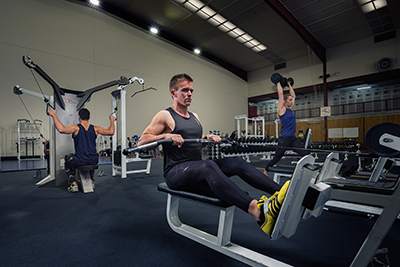
The core role of strength and conditioning coaches is to design, implement, and monitor safe and effective training programs for athletes. 1 They ideally work with other support team members - such as the head coach, nutritionists or dieticians, sports medicine staff and other medical practitioners (e.g. physiotherapists) – to achieve individual and team performance, rehabilitation, and/or recovery goals. 2, 3
Strength and conditioning coaches perform a broad range of tasks that contribute to individual and/or team sport performances, including: 2
- Screening athletes for potential injury risks or physical limitations that might impact performance.
- Providing activities to address identified general wellness issues (e.g. improving posture or breathing).
- Identifying or developing suitable testing protocols for various types of movement, flexibility, speed, endurance, strength, and power.
- Designing, implementing, and monitoring programs using a range of methods: resistance training, conditioning / energy systems training, speed and agility drills, flexibility, mobility, and warm up and warm down programs in various settings.
- Monitoring and assessing progress via physical testing, wellness monitoring, and other monitoring systems/technology (e.g., Heart rate variability, Global Positioning Systems).
- Providing general information on basic physiological recovery modalities.
Groups, societies and professional bodies
Exercise & Sports Science Australia, opens in a new tab (ESSA) is a peak professional organisation representing about 11,000 members, including student members. They are committed to establishing, promoting and representing the career paths of tertiary-trained exercise and sports science practitioners including Accredited Exercise Physiologists, Accredited Exercise Scientists, Accredited Sports Scientists, and Accredited High Performance Managers.
The Australian Strength and Conditioning Association (ASCA), opens in a new tab is the lead body for strength and conditioning coaches in Australia, representing over 6000 accredited coaches, coaching athletes and teams across all levels of sport.
The aim of the ASCA is to 'bridge the gap between sports science and practical application'. They conduct professional coach education courses (Level 1,2,3) that are recognised through the National Coach Accreditation scheme. The association also publishes the 'Journal of Australian Strength and Conditioning' (JASC), a refereed research publication that covers all aspects of strength and conditioning.
Vocational educational training
The path to becoming a strength and conditioning coach blends coursework, practical training, and experience. The ASCA provides a range of accreditation options from introductory/entry level through to professional, elite, and master.
To work at an elite level in Australian sport an undergraduate degree in in exercise, movement science, sports science, or a related field is required, as well as additional ASCA accreditation.
Standards
The Australian Performance Support Practitioner Minimum Standards represent the minimum standards for Performance Support staff and contractors engaged to deliver professional services in identified practice disciplines by National Sporting Organisations (NSOs), National Institute Network (NIN) partners, the Australian Olympic Committee, Paralympics Australia, and Commonwealth Games Australia. These standards, along with the AIS Sport Science Sport Medicine Best Practice Principles are a recommendation within the National Integrity Framework, opens in a new tab.
Strength and conditioning standards
Professional Qualifications:
- Bachelor’s degree in Exercise, Movement Science, Sports Science, or a related field.
Professional Accreditations:
- ASCA Professional Coach Level 2.
- Current International Society for the Advancement of Kinanthropometry (ISAK) accreditation is required if conducting skinfold testing
The AIS develops evidence-based position statements on new and complex topics in sports science and sports medicine to provide guidance and leadership for the Australian high-performance sports system.
Research and resources
- National Institute Network Research. Recently published sports science/sports medicine research from NIN researchers. This list is updated on a monthly basis.
- Blood flow restriction training guidelines, Australian Institute of Sport, (February 2021). These guidelines are intended to inform the safe application of Blood Flow Restriction (BFR) training. They may also be used as a reference for the development of minimum standards by National Sporting Organisations.
- National protocols for the assessment of strength and power, National Institute Network/Australian Institute of Sport, (version 2; 202?). These protocols outline updated testing methods for strength and power assessment that have a sound theoretical basis but are also practical in the training environment.
- Training load in relation to loading and unloading phases of training, Australian Institute of Sport, (version 2; 2021). This can be used by coaches, performance support team members and organisations in the national high performance sport system as a resource to guide conversations relating to holistic approaches to well-periodised and individualised training load planning following unloading.
Journals
- Journal of Applied Physiology, opens in a new tab publishes high quality original research and reviews that examine novel adaptive and integrative physiological mechanisms in humans and animals.
- Journal of Sport Sciences, opens in a new tab publishes research on various aspects of the sports and exercise sciences, including anatomy, biochemistry, biomechanics, performance analysis, physiology, psychology, sports medicine and health, as well as coaching and talent identification, kinanthropometry and other interdisciplinary perspectives.
- Journal of Australian Strength and Conditioning, opens in a new tab, a refereed research publication that provides original research, case studies, exercise highlights, interviews and reviews of the literature, on a wide variety of strength and conditioning topics.
- Journal of Strength and Conditioning Research, opens in a new tab promotes the publication of peer-reviewed manuscripts which add to our understanding of conditioning and sport through applied exercise science.
- National Strength and Conditioning Association (NSCA) Publications, opens in a new tab, provides links to various publications from the NSCA focussed on the newest findings in strength and conditioning research and its practical application.
- Strength and Conditioning Journal, opens in a new tab, a professional journal for strength coaches, personal trainers, physical therapists, athletic trainers, and other health professionals working in the strength and conditioning field, publishing both practical applications of research findings and the knowledge gained by experienced professionals.
Videos
* Licencing restrictions apply to some resources.
- Strength and Conditioning Network Day, Australian Institute of Sport, Canberra, (29 October 2024).
- Consistency and minimum effective dose for canoe slalom physical prep, Nick Perry, Physical Performance Specialist - Slalom, Paddle Australia.
- The impact and limitation of S&C on performance, Cory Innes, Strength and Conditioning Lead, Athletics Australia.
- Blending Coaches Eye with Tennis Data; Improving End-Range Movement Success, Alistair Murphy, Applied Sport Science Manager, Tennis Australia.
- Creating a High Performance Environment at the Games, Matt Hass, S&C Lead, Australian Olympic Committee.
- Q&A with Greg Smith, Strength and Conditioning Lead, Wheelchair Rugby.
- Strength and Conditioning AMS Dashboard, Michael Cianciosi, Athlete Management System (AMS) Manager.
- The Science Behind the Australian Track Cycling Team, Toby Edwards, AUS Cycling.
REFERENCES
- Coach Accreditation Framework, opens in a new tab, Australian Strength and Conditioning Association, (2022).
- Scope of practice: ASCA accredited S&C coaches, opens in a new tab, Australian Strength and Conditioning Association, (2024).
- Strength and Conditioning, opens in a new tab, Sport Ireland Institute, (accessed 7 January 2026).
- What is Strength and Conditioning (S&C)?, opens in a new tab International Universities Strength and Conditioning Association, (accessed 7 January 2026).
Related topics
Last updated: 7 January 2026 Content disclaimer: See Clearinghouse for Sport disclaimer
Is this information complete? The Clearinghouse for Sport is a sector-wide knowledge sharing initiative, and as such your contributions are encouraged and appreciated. If you would like to suggest a resource, submit a publication, or provide feedback on this topic, please contact us.