What needs to happen
Community sport is far too diverse for one Action Plan to fix every problem in every place. But we can start with the things that matter the most. Many of those who were engaged through the co-design process of this Action Plan, said that they want to see clearer action and have broader involvement, so that strengthening sport volunteering feels like a team effort.
Focus Areas
Led by our guiding principles, we have focused this Action Plan on three key areas for change:
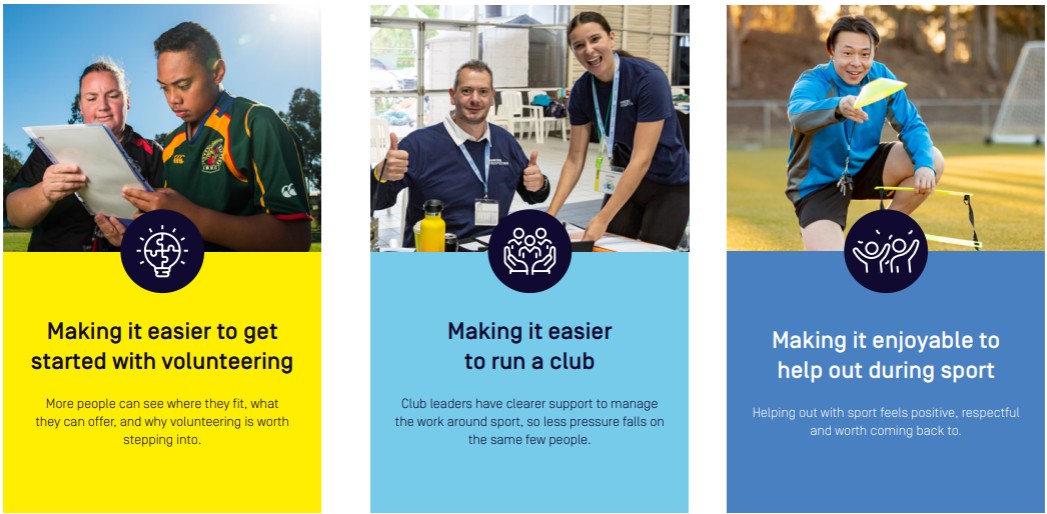
1. Making it easier to get started with volunteering
More people can see where they fit, what they can offer, and why volunteering is worth stepping into
People care deeply about sport and community. Many people are open to helping out, including people who may not already be players, former players or parents at a club.
But volunteering does not always look easy, visible or inviting to step into. Too often, people hear about volunteering when something is already under pressure. Perhaps a role needs to be urgently filled at school athletics, or a committee is stretched and needs help right away. This can make volunteering feel like something people might get stuck with, rather than something they would choose to do.
This focus area is about changing that first impression. Volunteering should feel welcoming and worth trying. People of all ages should be able to see where they could fit, how their skills could make a difference, and what they might gain such as connection, support networks, and the chance to contribute to positive change in their community.
Volunteering needs a better invitation. People are more likely to step in when the ask is clear, realistic and connected to something they care about or know how to do.
The value of volunteering needs to be easier to see, and it can be as much about community as sport. It can build confidence, skills, friendships and belonging. These benefits should be made more visible to support more connections to sport volunteering.
There needs to be more than one way to help, Not everyone can take on a formal role or an open-ended commitment. Some people may be able to help once, help online, share a skill, support an event or take on a small task.
The first experience matters. People remember how they are welcomed, whether the role is clear, and whether the club feels safe, respectful and organised enough to return to.
More people need to see themselves in volunteering. If opportunities are only shared through the same networks, clubs will keep drawing from the same pool. This makes it harder for younger people, culturally diverse communities, people with disability, time-poor families and people outside existing club circles to see a way in.
- Ensure existing volunteering support resources can reach clubs through channels they trust
- Help clubs reach new volunteers through community-based connectors
- Support practical use of the ASC Sport Volunteer Experience Framework
- Make existing national resources easier to find and use
2. Making it easier to run a club
Helping club leaders spend less time navigating administration, compliance and systems, and more time supporting the people who make sport happen.
Running a club can feel like running a small business. Committee members and club leaders are often trying to manage governance, finances, safeguarding, facilities, grants, technology, volunteer coordination and difficult conversations at the same time. Some bring professional skills to these roles. Others step in because someone needs to, then find themselves carrying responsibilities they were never trained or supported to manage.
Club work has become more complex, and too much of that complexity lands on volunteers. Making it easier to run a club means reducing unnecessary burden, making support easier to access, promoting more sustainable volunteering models that reduce burnout, and helping volunteers focus on the parts of community sport that matter most.
Club leadership roles are carrying more than many people expect. People step into a committee or office-bearing role often with little guidance from people before them and quickly find themselves dealing with governance, finance, reporting, safeguarding, workplace safety, technology and complaints. Some of this work is important and necessary, but it can still feel like a lot for volunteers to carry so burnout is common.
Governance, compliance and paperwork can feel heavy. Clubs described a growing amount of ‘admin around sport’ including forms, policies, training, reporting, accreditation, grant requirements and disconnected systems. These requirements support important outcomes such as safety, integrity or inclusion, but the way they land can add pressure to already stretched volunteers.
Support exists, but it does not always reach clubs in useful ways. Tools and resources are already out there, but knowing what is relevant, where to find it and how to use it when people are short on time is challenging.
Not every club has the same capability or capacity. Some clubs have people with strong professional skills while others are relying on goodwill, memory and improvisation. Support needs to fit where clubs are, rather than assuming every club is the same.
Some problems are too big for clubs to solve alone. Compliance, duplicated systems, accreditation costs, repeated training and fragmented guidance require system-level action. Clubs can improve how they work, but they need the system around them to reduce unnecessary burden where it can
- Advocate for more proportionate compliance reform for clubs
- Strengthen Game Plan's support for running a club
- Establish a quality and trust framework for club support resources
- Strengthen the local support that clubs rely on
- Study the feasibility of shared services and professional support models
- Support club leaders and administrators to undertake practical learning opportunities
- Embed safe and responsible AI into club practices
3. Making it enjoyable to help out during sport
Helping people feel supported and respected as they help make sport happen, so volunteering feels safer, more rewarding and worth coming back to.
For many people, helping out when sport is underway is the part of volunteering that feels most rewarding. You can see the impact of your contribution in real time: sport runs, people take part, teams play, families gather, and people of different ages and backgrounds share a moment around something that matters to them.
But this can also be where volunteering feels hardest. People told us that community sport can sometimes feel more intense than it needs to. A local game or event can start to feel like a high-stakes competition. Volunteers can be treated like paid staff, without the support or respect that should come with that. Families can forget that the person helping is giving their time. A poor experience can quickly undermine confidence and make it harder to come back.
Making it enjoyable to help when sport is happening means protecting the parts of community sport that people value most, while giving volunteers clearer backing when things get hard. The aim is to keep the experience enjoyable, respectful and worth coming back to
The environment around sport shapes whether people come back. Helping out can feel rewarding when the environment is respectful and the role feels clear. Roles can quickly become stressful when exposed to poor behaviour or unrealistic expectations.
Community sport can feel too much like professional sport. People told us that local sport can be more intense than it needs to be, driven in part by associations with the competitiveness of professional sport and parents’ ‘winning’ mentality. This can take away from the fun and connection that make community sport worth being part of.
Helping out should feel connected to the good parts of sport. People value the fun, friendships and local relationships that form around community sport. These parts of the experience are often what make volunteering feel worthwhile.
Clubs should not be left to manage behaviour and culture alone. Sporting bodies, leagues, governments, and community organisations all have a role in helping clubs create respectful environments, with clear expectations about what is acceptable and what is not
- Continue recognition initiatives and broaden the stories they tell
- Establish a national code of conduct for respectful behaviour towards sport volunteers
- Embed volunteers in Play Well culture change work
Stay updated!
Keep connected to the ASC for all things sport volunteering such as resources, case studies, news and events.